
Book Descriptions
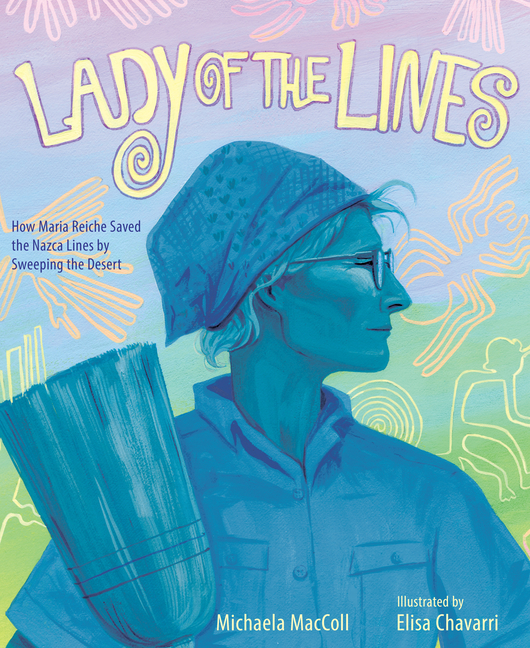
for Lady of the Lines by Michaela MacColl and Elisa Chavarri
From Cooperative Children's Book Center (CCBC)
One woman’s dedication brought attention and protection to the Nazca Lines, ancient scratches in the Earth’s surface visible from space. Maria Reiche was a German whose curiosity led her to travel to Peru in 1941. An American anthropologist introduced her to the Nazca lines, huge images carved into the Peruvian desert by the Nazca people, whose civilization existed from 500 BCE to 500 CE. With ordinary brooms, Maria swept the desert sand and rocks to uncover the images, whose meaning is still disputed today. Since the images were far too large to see in whole from the ground, she took measurements so that she could draw what she discovered. Later viewing the enormous images from a helicopter, she reported that “flying is the only way you can see the full beauty of the lines.” When the desert was scheduled to be flooded for irrigation, she led efforts to protect the Nazca lines, which are now a UNCESCO heritage site. After decades in the bright, hot desert, Maria lost her sight and needed to use a wheelchair, but she never regretted her life’s work. Photographs, a timeline, and additional information about the Nazca, including theories about the lines, round out this entrancing true story.
CCBC Choices 2026. © Cooperative Children's Book Center, Univ. of Wisconsin – Madison, 2026. Used with permission.
From the Publisher
A Booklist Editor's Choice
Evanston (IL) Public Library 101 Great Books for Kids
CCBC Choices 2026
When scientist and explorer Maria Reiche visited Peru’s Nazca Lines in 1941, she was immediately captivated by the larger-than-life animal carvings. But what were they, and why were they there? This STEAM nonfiction picture book for young readers reveals the story behind one of the greatest indigenous artworks in the Americas, now a UNESCO World Heritage Site.
Maria Reiche wanted to put her curious mind to the test. When visiting Peru in 1941, she trekked across the land and discovered hidden lines covered in centuries of clay and sand. Fasciated, she picked up a broom from her tools and began sweeping for miles and miles to uncover more details, taking time to track her movement and sketch out the precise shapes she followed. Her first discovery was a spider-shaped carving spanning hundreds of feet of desert! Sweeping her way across the land, other shapes followed—a monkey, a condor, and a whale. But in the midst of these discoveries, she found out the land was going to be used for farming. She got to work again, this time demanding a press conference to announce her discoveries and stop the destruction of these ancient works of art—and it worked! Her efforts protected the land, which was later named a UNESCO World Heritage Site in 1994 thanks to Maria’s tireless efforts.
Author Michaela MacColl’s lyrical writing and extensive research showcase Maria’s triumphant tale, accompanied by art from Peruvian illustrator Elisa Chavarri, a past recipient of the Pura Belpré Honor.
Evanston (IL) Public Library 101 Great Books for Kids
CCBC Choices 2026
When scientist and explorer Maria Reiche visited Peru’s Nazca Lines in 1941, she was immediately captivated by the larger-than-life animal carvings. But what were they, and why were they there? This STEAM nonfiction picture book for young readers reveals the story behind one of the greatest indigenous artworks in the Americas, now a UNESCO World Heritage Site.
Maria Reiche wanted to put her curious mind to the test. When visiting Peru in 1941, she trekked across the land and discovered hidden lines covered in centuries of clay and sand. Fasciated, she picked up a broom from her tools and began sweeping for miles and miles to uncover more details, taking time to track her movement and sketch out the precise shapes she followed. Her first discovery was a spider-shaped carving spanning hundreds of feet of desert! Sweeping her way across the land, other shapes followed—a monkey, a condor, and a whale. But in the midst of these discoveries, she found out the land was going to be used for farming. She got to work again, this time demanding a press conference to announce her discoveries and stop the destruction of these ancient works of art—and it worked! Her efforts protected the land, which was later named a UNESCO World Heritage Site in 1994 thanks to Maria’s tireless efforts.
Author Michaela MacColl’s lyrical writing and extensive research showcase Maria’s triumphant tale, accompanied by art from Peruvian illustrator Elisa Chavarri, a past recipient of the Pura Belpré Honor.
Publisher description retrieved from Google Books.
