
Book Descriptions
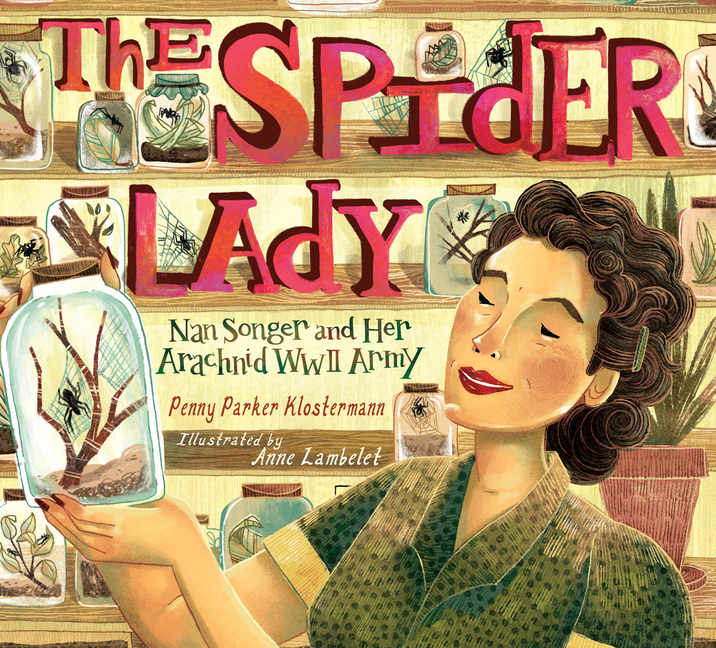
for The Spider Lady by Penny Parker Klostermann and Anne Lambelet
From Cooperative Children's Book Center (CCBC)
Interested in “bugs” since she was a child, a remarkable citizen scientist turns her passion into a career. Nan Songer (white) found pleasure in observing living specimens, an inclination that led to a vast collection of creatures in her home. When a friend informed her that he had used spider’s silk to repair his surveying scope, Nan’s brain lit up. Could she harvest and sell spider silk to make crosshairs in gunsights, periscopes, and more for use in the war? Through trial and error, and with much creativity, Nan discovered that a spider’s dragline, which is cast out when it falls from a height, is optimal; that spiders can be held harmlessly in place with hairpins while their silk is extracted; that a small lightbulb in a popcorn can will illuminate the silk without overheating the spider; that sudden, loud noises can cause spiders to spin a different kind of silk; and that different species, ages, and sexes of spiders spin silk with different characteristics. After testing the silk of more than 50 species, Nan found that the silk of black widows was optimal, and that it could be split or combined with the silk of other spiders, depending on the weight needed. A detailed narrative illuminates the innovation, successes, and challenges behind Nan’s awe-inspiring work.
CCBC Choices 2026. © Cooperative Children's Book Center, Univ. of Wisconsin – Madison, 2026. Used with permission.
From the Publisher
An ALSC Notable Children's Book
NSTA/CBC Outstanding Science Trade Book
2026 NSTA-CBC Best STEM Book Winner
CCBC Choices 2026
Perfect for kids who are fascinated by insects and American history, here is the story of Nan Songer, a little-known hero of World War II, who collected and bred spiders in her home and found new ways to use their silk to help the United States win the war.
Venomous spiders, delicate silk, and science experiments filled Nan Songer’s days and nights—her home in California overflowed with many-legged critters. With inspiration from a friend, Nan began to study how spider silk could be harvested. The finely woven material spiders used to create webs was much stronger than it looked, and Nan was eager to unlock its potential and hopefully help her country at the same time. At the height of WWII, she studied different spiders before landing on the poisonous black widow as the perfect spider to experiment with. Their strong silk could be used for crosshairs on rifles, which Nan used to fill massive orders for the US military. Despite the danger posed by black widows, Nan wasn’t deterred—she wanted to play her part. Using a device she built for extracting silk, Nan humanely used it on the deadly spiders to get both extra fine and super heavy silk.
NSTA/CBC Outstanding Science Trade Book
2026 NSTA-CBC Best STEM Book Winner
CCBC Choices 2026
Perfect for kids who are fascinated by insects and American history, here is the story of Nan Songer, a little-known hero of World War II, who collected and bred spiders in her home and found new ways to use their silk to help the United States win the war.
Venomous spiders, delicate silk, and science experiments filled Nan Songer’s days and nights—her home in California overflowed with many-legged critters. With inspiration from a friend, Nan began to study how spider silk could be harvested. The finely woven material spiders used to create webs was much stronger than it looked, and Nan was eager to unlock its potential and hopefully help her country at the same time. At the height of WWII, she studied different spiders before landing on the poisonous black widow as the perfect spider to experiment with. Their strong silk could be used for crosshairs on rifles, which Nan used to fill massive orders for the US military. Despite the danger posed by black widows, Nan wasn’t deterred—she wanted to play her part. Using a device she built for extracting silk, Nan humanely used it on the deadly spiders to get both extra fine and super heavy silk.
Publisher description retrieved from Google Books.
